The Wall
A Court of Thorns and RosesThe Wall is the invisible boundary separating the mortal realm from Prythian, the central political and material remnant of the Treaty forged after the War. Although created to end centuries of enslavement and bloodshed, it never produces genuine security: mortals remain crowded into a poor territory beside an immortal power, while breaches allow dangerous faeries to cross. As the story progresses, The Wall changes from a distant object of inherited fear into a physical threshold that can be tested, crossed, and weaponized, revealing the collapse of the order it was meant to preserve.
Origin and Political Function
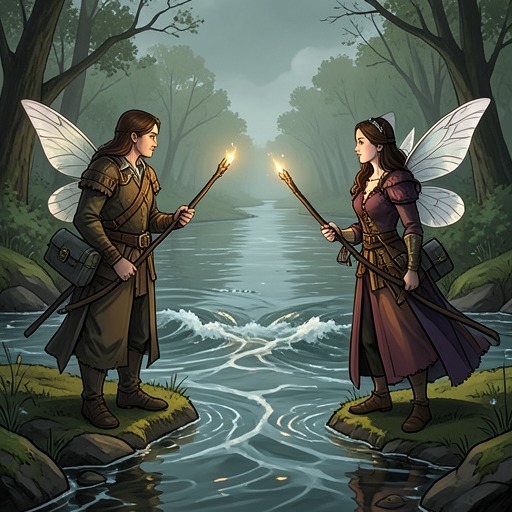
The Wall was constructed when six mortal queens forged the Treaty that ended the War between humans and the High Fae and faeries. Before that settlement, humans had been enslaved for millennia, compelled to build the glorious civilizations and temples of their High Fae overlords. The postwar division assigned the North to the High Fae and faeries, who carried their magic with them, while mortals were confined to the South and left to survive by working the earth. The Wall therefore embodies both liberation and dispossession: it ended direct enslavement, but it also fixed an unequal geography in which human freedom existed within a narrow, vulnerable territory.
For the mortal communities living near it, The Wall is less a reassuring defense than a maintained illusion. The territory is too small and poor to support a standing army to patrol the border, so villagers depend on the Treaty rather than force. Wealthier landowners can hire mercenaries to guard estates bordering Prythian, but such protection is still understood as inadequate. Iron bracelets, charms, baubles, incantations, and threshold markings offer another form of comfort, yet even these measures are treated as gestures that might buy only a few minutes. The common teaching is that running and fighting are both futile against the High Fae.
A Border Built from Fear
The Wall shapes mortal knowledge even when it remains unseen. Children hear warnings about the High Fae from infancy, and stories of creatures slipping through the boundary turn geography into a permanent threat. A mercenary reports that a pack of martax crossed The Wall and tore half a village apart, while other accounts claim that attacks have been growing worse over roughly fifty years. No one knows whether the High Lords’ control over their beasts is failing or whether the incursions are deliberate, but the uncertainty itself becomes part of the border’s power.
Human settlement beside Prythian is presented as an inherited danger with no convincing explanation. The Treaty has lasted for centuries, yet rifts and holes in the warded boundary are large enough for lethal creatures to enter the mortal territory and torment its inhabitants. The Wall thus separates the realms without making them independent. It keeps magic and political authority on one side, but cannot prevent violence, rumor, fear, or covert movement from passing between them.
Physical Encounter and Crossing
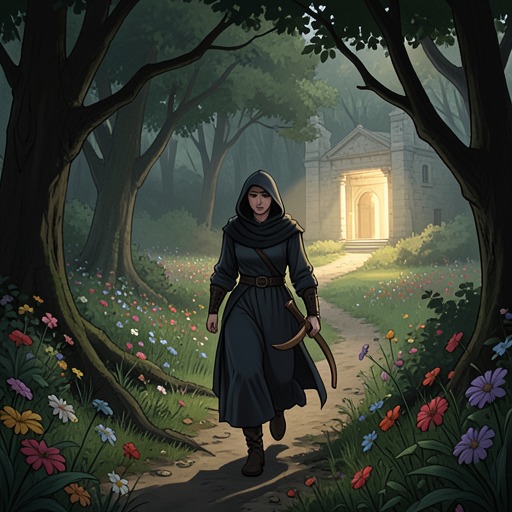
The Wall is first experienced as an absence made solid. During her return journey, Feyre Archeron rides through the summer forest until an absolute silence falls. Her horse bucks, shakes her head, and refuses to proceed, although no marker or visible obstruction appears. When Feyre dismounts and reaches forward, her hand meets an impassable surface: an invisible wall cleaving through the forest.
The boundary is not uniformly sealed. Feyre knows that faeries can pass through holes, and she leads her horse along the line, tapping the unseen barrier to keep her direction. After two days, including a night she finds more terrifying than any she experienced at the Spring Court, she discovers two mossy stones facing one another with a faint whorl carved into each. Together they form a gate. When she guides her horse between them, magic stings her nostrils and makes the animal buck, but the passage succeeds. The scene gives The Wall a physical grammar of resistance, openings, markers, and crossings: it is an enforced border, yet also a damaged one.
Feyre’s earlier passage has a different character. It takes two days to travel from her cottage to The Wall and enter the southernmost border of Prythian, and she suspects that an enchanted sleep may have concealed the journey. The gate there opens without a porter or sentry, and the beast leading her continues through while her horse follows. The absence of guards emphasizes that the boundary is governed by magic and political arrangements rather than ordinary human institutions.
Collapse Under Amarantha
The Wall’s weakening is inseparable from the crisis in Prythian. Tamlin explains that the blight is not an ordinary disease but a force directed at magic and those living in Prythian; it might eventually affect mortals and their territory, although it has moved slowly and remained stable for decades. Later, Alis reveals that the supposed blight is actually Amarantha. The borders are collapsing because she has reduced them to rubble, and she sends creatures across them to test what strength Tamlin has left.
Amarantha’s rise also explains why the border has become an instrument of imperial expansion. After presenting herself as a courtier seeking trade, communication, and shared resources between Hybern and Prythian, she secretly used trade ships to transport her personal forces. Once she had weakened the seven High Lords by stealing much of their power, she seized Prythian and ruled it for forty-nine years from her palace beneath the sacred Mountain. Her regime gathered the most vicious creatures in Prythian and Hybern, offering them sanctuary while building an army for a future assault on the human world.
Under this system, incursions into mortal territory are no longer random failures of containment. If faeries cannot cross The Wall without Amarantha’s permission, then the increasing attacks on humans bear the mark of authorization. The border that once formalized peace becomes a staging mechanism for conquest, while its apparent protection conceals the preparation of war. Even the murder of Clare Beddor and her family is understood within this logic as a possible order issued through Amarantha’s power.
Narrative Significance
The Wall organizes the novel’s central oppositions—human and High Fae, safety and exposure, home and exile, freedom and confinement—but repeatedly frustrates any simple separation between them. It was built to divide former masters from former slaves, yet the mortal realm remains economically dependent on the Treaty and militarily unable to defend itself. Its invisible surface makes political violence feel naturalized: people live beside a danger they cannot see, maintain rituals of protection they know may fail, and inherit fear as practical knowledge.
Its eventual physical crossing also marks a change in Feyre Archeron’s position. The first crossing takes her out of the human world and into Prythian, while the later search for a gate turns her return into an active confrontation with the boundary. The Wall is no longer merely the line that others have drawn around her life. It becomes a threshold she must locate and negotiate, just as the novel’s larger conflicts force her to move among mortal, High Fae, captive, and transformed identities. Even the final imagery of her resurrection—blackness bordered with gold, followed by her return to the throne room—echoes the book’s recurring concern with barriers between death and life, imprisonment and release, and one world and another.